
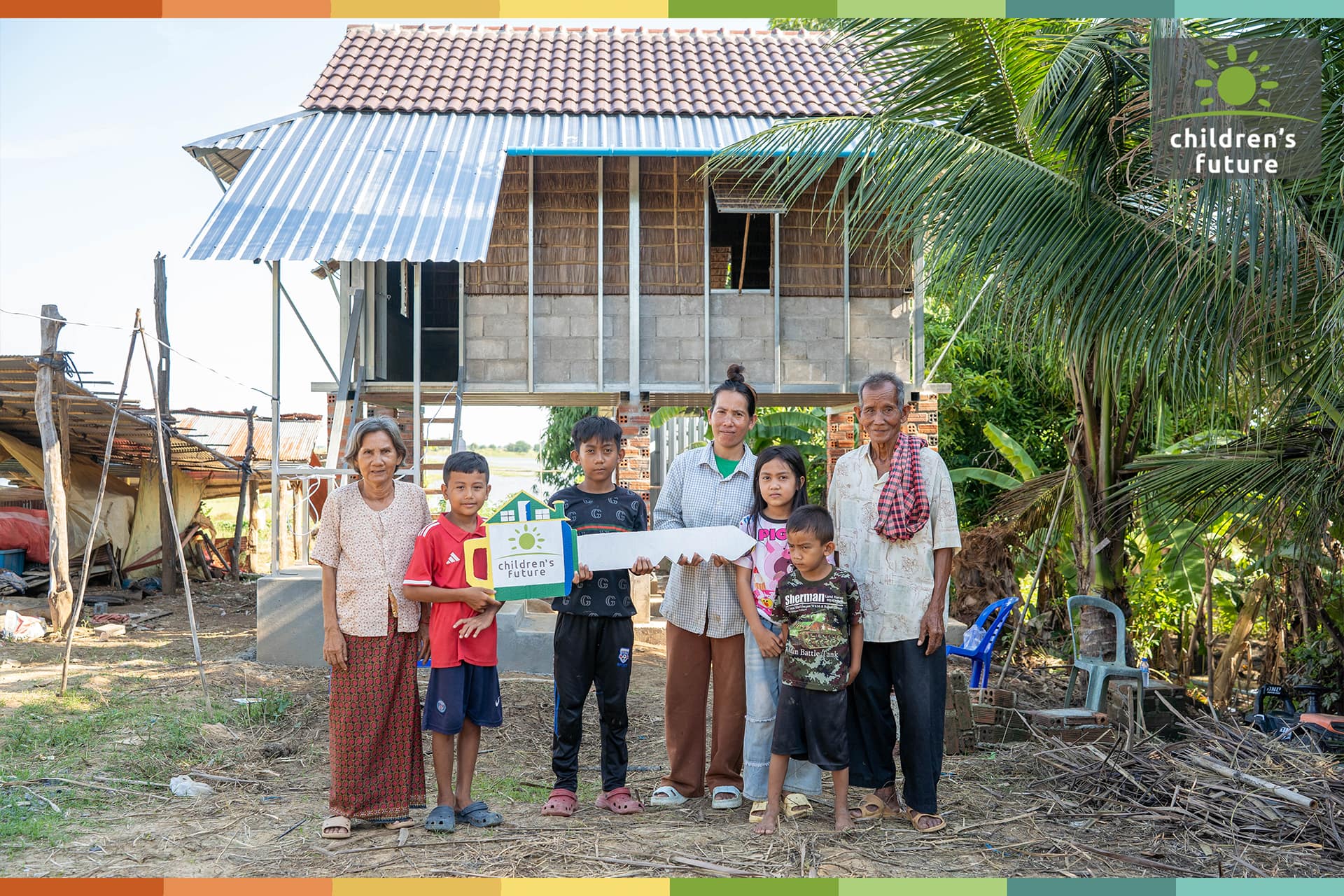
For 11-year-old Sokha (pseudonym) and his two younger siblings, the sound of rain once brought fear instead of comfort. Each storm threatened to collapse his family’s fragile wooden house, where rotting, termite-damaged pillars and holes in the roof and walls offered little protection. When rain poured inside, the family struggled to sleep, worrying about their safety.
Sokha lives with his extended family of 13 people in Ek Phnom District, Battambang Province. With so many family members to support, life was already difficult. They also lacked a proper toilet, forcing them to share an old, deteriorating facility with nearby relatives.
Farming provided barely enough rice to feed the family, which can be challenging due to unpredictable market prices and changing weather which can severely affect their harvest. To find more income for the family, Sokha’s father migrated to Phnom Penh for construction work, while other relatives sought employment in Thailand.
However, the Cambodia-Thailand border conflict forced family members to return home, leaving their jobs and income behind. As financial difficulties worsened, the family struggled to afford food and school supplies, putting Sokha at serious risk of dropping out of school.
Recognizing the family’s urgent needs, Children’s Future International (CFI) opened a case management intervention on April 7, 2026. CFI provided emergency cash assistance to help cover essential household expenses. Sokha and his siblings also received school supplies, uniforms, a bicycle and helmet, and a bike light to help him continue his education. CFI also provided family education sessions on Positive Parenting, Child Protection, Safe Migration, Health and Hygiene, and Financial Management.
As a more long term solution, CFI helped them build a new house and proper toilet. This has helped ensure that Sokha’s family no longer lives in constant fear whenever it rains, helping keep the family safe and the kids attending school consistently. Sokha and his younger siblings were overjoyed to move in, happily chatting and playfully competing to claim their sleeping spaces.
With greater peace of mind, their parents feel encouraged to rebuild their livelihoods. Sokha is happier, attends school regularly, and has shown noticeable improvement in his academic performance.
As the caseworker who has supported this family from the beginning, witnessing their transformation has been deeply moving.
For Sokha and his family, a safe home is no longer just a dream. It is the beginning of a brighter future.